Louis Burdet, French gentleman, London hôtelier, special agent
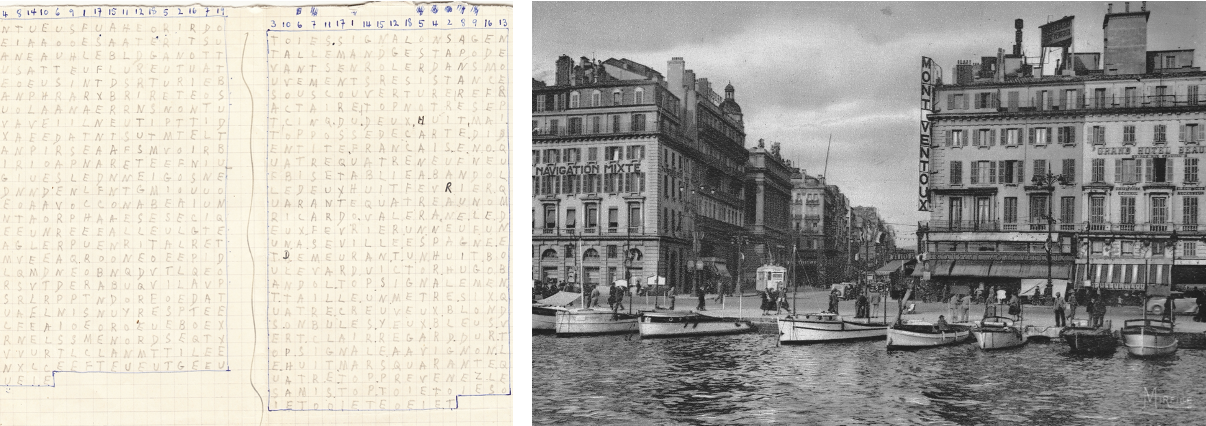
Midnight had come and gone, Marseille was fast asleep. In a sparsely furnished flat behind the Vieux-Port, the air thick with cigarette smoke, four agents were busy decoding secret messages from London. Out of the silence, the drone of an engine was heard. Immobile, their pencils in the air, they listened as the car drew nearer, finally screeching to a halt.
« It’s for us! » They jumped to their feet and looked at each other – who had betrayed them
It was Spring 1944, and among them, CIRCONF’ as he was known to his men was one of the most important men of the Provençal Resistance.
CIRCONF’ checked the camouflage on the window. Two car doors slammed shut. Hurried footsteps on the tarmac were heard. The occupants of the car, hammering on the building’s communal entrance, shouted in a guttural accent: « German Police ! Open up ! » In a flash, all compromising material was burned in the stove. Setting the scene, CIRCONF’ grabbed a pack of cards, dealing them out to each of the four “players”, sitting around an ashtray full of stubs, eyes wide and heart beating fast.
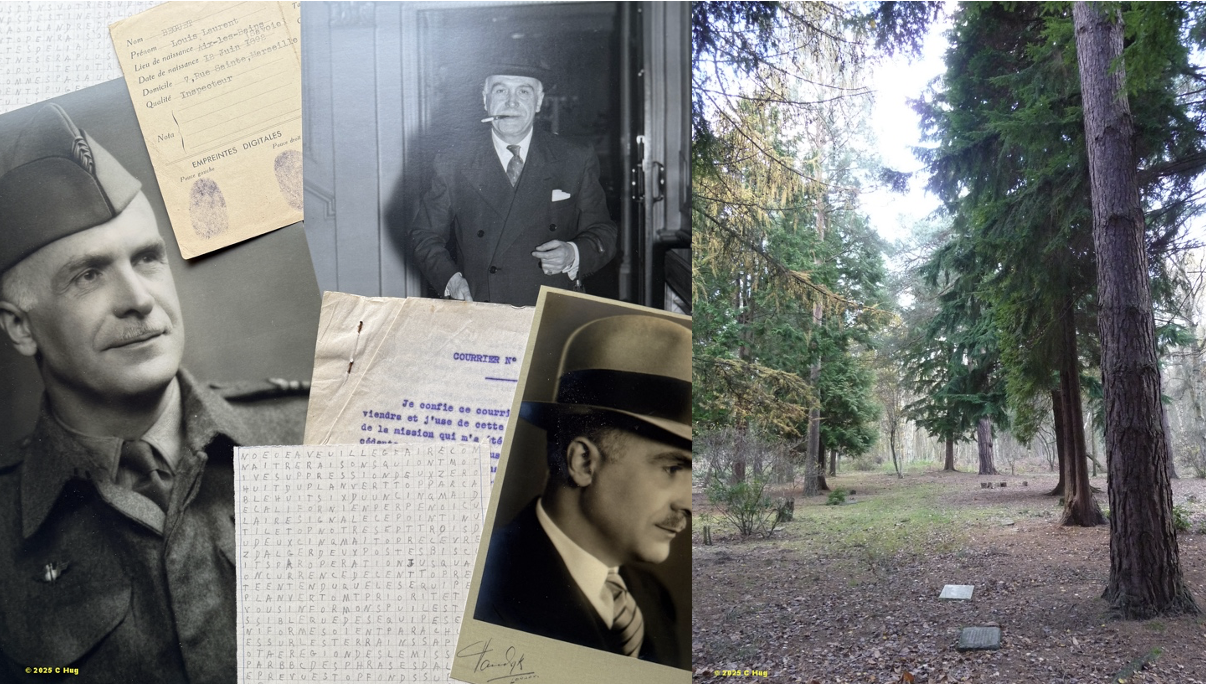
Prior to his engagement in the shadow forces, Louis Burdet, his real name, had been a well-known figure in London as the manager of the palatial Hyde Park Hotel. Always a dapper gentleman, in the “suit, brollie and hat” mould, both before and after his stint in clandestinity.
Burdet heard de Gaulle’s appeal on the radio on 18th June 1940 and he offered de Gaulle his services the day after. It was not clear yet what he could do for the cause so he contented himself with fire-watching on the roof of his hotel, joining the Home Guard and making himself useful to British intelligence.
He was in constant contact with the Free French as personnel of the highest ranks were frequently billeted at the Hyde Park Hotel, including de Gaulle in his early days in London. Also through his wife who had a commanding role in the women’s unit.
It was only in September 1943 that he was allowed to start training in SOE training camps. About his instructors he wrote:
“I put it on record that, by their tact, patience and understanding, those young Britons made us all feel thoroughly at home and gave us groundwork of such meticulous detail that, when we arrived in France, we were ready for every eventuality, even to poaching game for a living, and on many occasions were able to save our very lives. This tribute also applies to the various feminine units corresponding to the three Services, representatives of which, - particularly the FANY and the MTC - drove us or gave us practice in code work with a sympathetic devotion and discretion truly to be admired.
We were hardened by intense physical training. I learnt sabotage of every kind, the use of explosives, perfected our accuracy at shooting with all types of weapons. We learnt how to get messages and supplies through the strictest cordons; how to hide ourselves and arms; how to smuggle all kinds of goods; how to provide alibis for ourselves, and – last not but not least – how to use legitimate forgery as well as cool and barefaced lying.”
All this would serve him in good stead during his mission. This extract also shows what a kind and generous man Burdet was, very attuned to people around him, a people’s person one would say now.
From the get-go he was trained by SOE’s RF Section for an important role in the Resistance. Finally, on the night of 8/9 February 1944, CIRCONFÉRENCE, aged nearly 44, married and a father of two, landed in occupied France, as part of a famous RF operation. Burdet described his arrival thus:
"So I weathered the training, yet after 12 unsuccessful attempts, washed out by weather conditions, and after twice circling for 8 hours over France and returning because either the field on which we were to be dropped was covered in fog or showed no signals, it was an anti-climax that when I did land in France during the first few days of February 1944, it was by stepping out of a bogged Lockheed-Hudson, and not at the end of a parachute”.
He arrived in Provence as “chef de région” - also known as DMR (délégué militaire de région). The DMRs were imposed by the British onto the Free French after the disaster of Caluire and Jean Moulin’s death, for security and efficiency reasons, but they were not always easily accepted by the local resistance. CIRCONFÉRENCE’s role was to coordinate paramilitary action across the seven départements of Military Region R2, on the Mediterranean coast.
His mission was to unite the disparate local Resistance movements, a continuation of Jean Moulin’s work. Indeed, he would need all his calm resolve and mediation skills to deal with the complex and fractious local Resistance.
All of CIRCONFÉRENCE’s work was building up to D-Day: Initially he recruited couriers to liaise with Lyon, the “clearing house” for all that came from England; he organised his HQ as well as sub-headquarters and how to communicate between them. He requested and allocated much needed arms and funds to the R2 Resistance, while his instructors trained the Maquis for guerrilla war. He coordinated all the “Immediate Action” operations in the region as part of the Allies’ high-priority Plan Vert for rail and road sabotage. The success of D-Day depended on the success of the Plan Vert, together with sister plans Plan Violet (damaging telecommunications) and Plan Tortue (attacking armoured vehicles).These acts of strategic destruction were designed to isolate the enemy, preventing the German army from sending ammunition and troop re-enforcements to the North of France following the June landings in Normandy.
It was expected that, when the enemy withdrew their troops to the Normandy front, they would destroy the important ports of Marseille and Toulon, rather than leave them for the Allies to use to their advantage. All ports in occupied Europe were classified according to importance, three of the ports deemed most important were French, and Marseille was one of them.
With this in mind, CIRCONFÉRENCE was given the highly dangerous mission of recruiting into the Resistance the reticent engineers of the Ponts-et-Chaussées, in order to organise the counter-scorching of dock installations (codenamed Plan Momie). This was a particularly delicate affair as the coastline and maritime industries were known to be riddled with informants for the enemy. Once recruited into the Resistance, these few port employees were to lie low before D-Day, gathering intelligence that would help the Allied naval forces to take control of the ports in the early stages of the landings. Any intelligence gathered would then be relayed to London by CIRCONFÉRENCE.
Congratulated on 19 May for reaching an agreement with the port engineers, CIRCONFÉRENCE’s dangerous work can be directly linked to the success of the Southern landings and to the historic and strategic Port of Marseille being saved from destruction.
From D-Day onwards, it was noted that in the seven departments of R2 for which CIRCONFÉRENCE was Military Delegate, “no enemy was ever safe, none reached even the Loire Valley, and most were in a sorry state when they had to face the St Tropez landings.”
Indeed the various Maquis and resisters of R2, who had before the Normandy landings, fought a clandestine opposition to the German occupation, engaged then the enemy in open warfare. This would have deadly repercussions. It was in this highly charged atmosphere that CIRCONFÉRENCE readied the R2 region for the second top secret landing, Operation ANVIL, later renamed DRAGOON.
What is even more remarkable is that he was taken out of action for 11 days at this crucial juncture. The Gestapo arrested him on 28th June in a contact’s flat and threw him in jail, with his host, a newspaper director (accused of printing clandestine tracts), and a comrade, himself a journalist. Thankfully his false identity and cover story were so well absorbed by him that the Gestapo did not know they had arrested one of the most wanted heads of the local resistance. He was freed for lack of evidence with his comrades on 8th July. Master of the British understatement, Burdet noted that the last 11 days had “seemed to me a very long time to be in Boche hands.”
On 15 August 1944, the Allies landed on the beaches of the French Riviera. This amphibious invasion was commanded by General Patch of the American 7th Army - with General de Lattre de Tassigny in charge of the 1st French Army. The Allies mounted a simultaneous assault on Marseille and Toulon. By the end of the month, both port cities were liberated.
The impact of the R2 Resistance on the success of DRAGOON is a credit to CIRCONFÉRENCE:
It was in large part due to his un-ostentatious tact and firmness that the resistance forces gave so splendid an account of themselves in August, reducing the effectiveness of the Germans who opposed the “Dragoon” landing to about two-fifths of their nominal strength.
He stayed in Marseille for a few months, as liaison with the American Army, further testing his mediation and negotiation skills! Back to civilian life with the rank of Colonel, decorated with French, British and American medals, CIRCONFÉRENCE became Louis Burdet once again. Not one to rest on his laurels, his strong sense of justice and loyalty demanded that he fought for his Resistance comrades to be remembered, recognised and compensated.
Lifelong friendships were forged in the intense months of the war, and Burdet remained close to several members of his network, even hiring several of his old associates. Indeed, Burdet could not wait to go back to running a hotel!
Helping SOE agent Nancy Wake put her domestic affairs in order in liberated Marseille, when she asked him what he would do now that the war was over, he replied:
“Go back to London, to an hotel. That is my job. I have had enough of playing at soldiers. I was only an amateur after all.”
The amateur hero became the general manager of the newly-opened Stafford Hotel in Mayfair – a favourite haunt of former secret agents, like Nancy Wake, for whom the Stafford was for a time a home, swapping Resistance stories with Burdet. He also led the Free French Association in London, taking part in organising the unveiling of the commemorative plaque at the old RF offices at 1 Dorset Square, as well as de Gaulle’s state visit to London in 1960.
Louis Burdet died in 1969 and is buried in Brookwood Cemetery, next to his friend Forest Yeo-Thomas who had died in 1964.
When I went with his daughter Jacqueline to pay our respects at his grave and that of Yeo-Thomas, I was stuck by how even more peaceful and secluded this area of the Cemetery was. To me who was delving into the staff and agents of SOE’s RF Section, the fact that this anglophile Frenchman and this francophile Englishman were buried next to each other was a most potent symbol of the friendship and the solidarity that had united the men and women fighting for France and freedom in the dark years of the Second World War.
Perhaps better than a commemorative plaque or street name: the port of Marseille still stands today – a tribute to Louis Burdet’s forgotten mission as CIRCONFÉRENCE.
Note: This is an edited extract of the forthcoming RF is for Real Friends, research enlivened with testimonies and unpublished documents. If you quote from this page please acknowledge and link to this source. Thank you. Any additional information gratefully received.
© CHug, 2025.